
Understanding Left Achilles Pain and Tendinopathy
The Achilles tendon is the strong band of connective tissue that links the calf muscles to the heel bone. It plays an important role in walking, climbing stairs, running, and stabilizing the ankle during athletic movement. Achilles tendinopathy is different from an acute Achilles tear or rupture. It generally develops gradually when repeated mechanical loading exceeds the tendon's ability to recover and adapt, leading to changes in the structure and organization of the tendon. Pain commonly occurs through the midportion of the tendon, often approximately 2–6 cm above its attachment to the heel. A typical pattern is stiffness or discomfort when first getting out of bed or beginning activity. The tendon may feel better once it has warmed up, only for discomfort to return after longer or more demanding activity. Age, previous tendon problems, diabetes, obesity, and repetitive mechanical loading are recognized risk factors. Foot mechanics such as increased pronation are an associated factor in some individuals rather than a universal cause. For golfers, repetitive loading is particularly relevant, and it helps explain why left Achilles pain can be stubborn once it takes hold. This broader, whole-body view is central to how we approach musculoskeletal conditions at Raleigh Health & Wellness Center.How Golf May Contribute to Left Achilles Pain
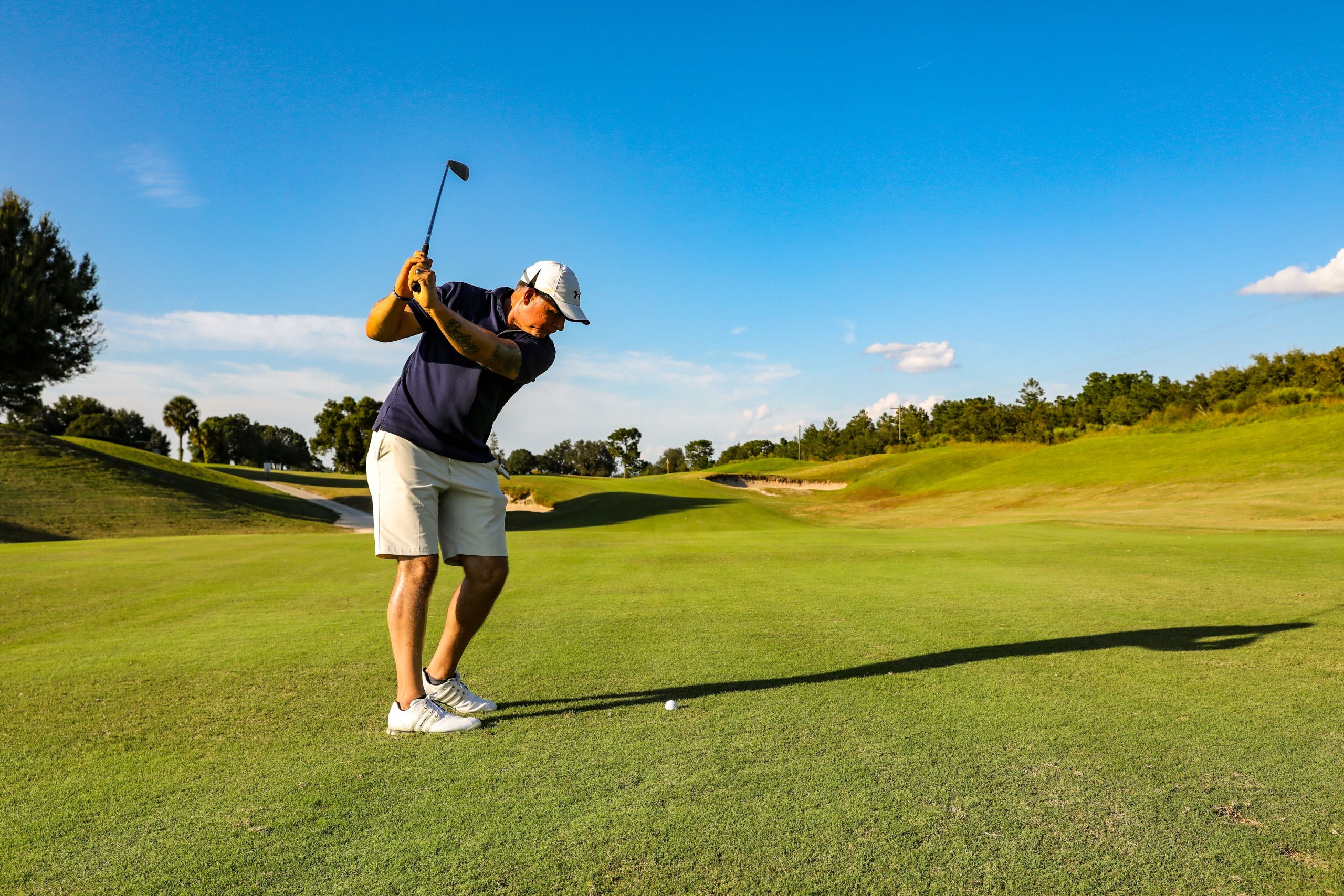
The golf swing is a powerful rotational movement that places substantial demand on the lower body. Rather than resulting from a single traumatic event, many golf-related musculoskeletal problems develop gradually through repeated loading and movement patterns, particularly in golfers who play frequently, spend considerable time at the range, or suddenly increase their practice volume. Because the golf swing is asymmetric, each leg performs a different role. Studies of swing biomechanics confirm that the lead leg experiences greater loading than the trail leg, and that lead-knee and lead-hip forces can exceed those of everyday activities such as walking. In a right-handed golfer, that lead leg is the left leg. It is worth being precise here: research documents high, asymmetric loading through the lead leg, but it has not directly measured Achilles or calf load during the swing, nor established golf as a proven cause of Achilles tendinopathy. The mechanical logic is sound, but the direct link remains an inference.Why Lead-Leg Loading May Cause Left Achilles Pain
As the golfer transitions from the backswing into the downswing and follow-through, body weight and ground-reaction forces move rapidly from the right side toward the left. Rapid weight transfer. During the downswing, force shifts quickly onto the lead foot. The left leg must accept and stabilize that load while the torso and pelvis continue to rotate, and the calf-Achilles complex participates in controlling force during every full swing. One swing is unlikely to create a problem; repeating the movement dozens or hundreds of times is a very different mechanical demand. Rotation through the front leg. As the golfer rotates through the ball, the tibia, knee, ankle, and foot must manage rotational forces while the golfer "posts up" onto the front leg. The left foot becomes an important pivot point, and this combination of loading and rotation increases mechanical demand throughout the lower leg and ankle. Repetitive volume. A single round involves dozens of full swings plus practice swings, warm-up shots, walking, hills, and uneven terrain. Golfers who play several times per week can expose the lead-side Achilles to hundreds of repeated loading cycles. Unlike walking or running, where both legs perform similar roles, the swing places distinctly different demands on the lead and trail legs — creating a repeated mechanical bias toward the left side that may contribute to left Achilles pain when volume increases faster than the tendon can adapt.How the Kinetic Chain May Affect Left Achilles Pain
Rehabilitation clinicians often think about Achilles pain in the context of the whole limb rather than the tendon alone. The hip, pelvis, knee, ankle, and foot function together as an interconnected chain, and when one region is not contributing effectively, another area may have to work harder. The gluteal muscles are relevant here. The gluteus maximus contributes to hip extension and forward propulsion, while the gluteus medius helps stabilize the pelvis and lower limb. Golf research specifically emphasizes hip-extensor function in generating swing power, and studies of gluteal tendinopathy show that hip abductor weakness alters pelvic and lower-limb control during single-leg loading. An honest caveat: the strongest direct evidence concerns how hip weakness affects the hip and pelvis themselves. The further step — that weak glutes offload work specifically onto the calf and Achilles — is biologically plausible and reflects common rehabilitation reasoning, but it has not been directly proven for the Achilles. It is a useful working framework, not an established fact. With that in mind, the general concepts still apply:- Sharing the work between hip and ankle. During walking, both the hip extensors and ankle plantarflexors contribute to forward movement. If the hip is not generating or controlling force effectively, the calf-Achilles complex may plausibly be required to contribute more.
- Pelvic control and lower-limb mechanics. Reduced control around the hip can influence knee and foot alignment during single-leg loading. If the pelvis drops or the hip moves inward, the knee and lower leg may follow, potentially altering foot mechanics and rotational demand through the ankle.
- Timing as well as strength. Muscle function is not only about strength but also about the timing and coordination of activation. For a golfer repeatedly transferring force through the lead leg, good coordination throughout the chain is important.
Why Golfers Develop Left Achilles Pain
Many recreational golfers sit for much of the working day, then walk onto a course, cover several miles over uneven terrain, and repeatedly perform a powerful rotational movement. That is a substantial change in physical demand. Sitting itself does not cause Achilles tendinopathy. However, hip mobility, lower-limb strength, conditioning, and overall load tolerance all influence how well the body manages activity. A golfer whose lower body is not adequately conditioned may ask the calf and Achilles to tolerate more work than they are currently prepared for.Why Left Achilles Pain Can Become Persistent
One frustrating feature of Achilles tendinopathy is that symptoms may appear to improve during activity — the classic "warm-up" pattern. The tendon may hurt at first steps, feel better after warming up, and then become painful again later. That temporary improvement makes it easy to keep playing even though the underlying load on the tendon has not changed. Several factors can perpetuate the problem:- The warm-up effect. Because symptoms often decrease after a few minutes, golfers may assume the problem is resolving and continue playing.
- Playing without enough recovery. Many golfers play year-round with no obvious off-season, so the tendon may never get a sustained period of reduced loading.
- Changing the swing because of pain. A golfer may unconsciously transfer less weight onto the lead leg, shorten the follow-through, or shift force toward the trail leg. This may reduce discomfort temporarily but can redistribute stress to the knee, hip, or lower back.
- Changes within the tendon. Once tendinopathy is established, structural changes may make the tendon tolerate load less effectively, particularly if activity keeps exceeding its capacity. Persistent pain can also become more complex over time and may be influenced by sleep, stress, movement patterns, and tissue sensitivity — themes explored further in our discussion of acupuncture for chronic pain.
Managing Left Achilles Pain in Golfers
Managing Achilles tendinopathy usually requires more than treating the painful area. Playing volume, calf strength, hip function, foot mechanics, conditioning, recovery, and swing biomechanics all matter.- Manage the load. Reducing total stress on the tendon is often an important first step — not necessarily stopping golf, but temporarily reducing rounds, limiting long range sessions, avoiding sudden increases in volume, and allowing more recovery. The goal is to bring load back within a range the tendon can currently tolerate.
- Build calf and Achilles capacity. Progressive strengthening is a cornerstone of rehabilitation. Both eccentric calf exercises and heavy, slow resistance training have strong evidence and produce comparable, durable improvements. The key word is progressive: enough stimulus to adapt without repeatedly exceeding current capacity.
- Strengthen the rest of the chain. Depending on the individual, this may include bridges, hip thrusts, lateral band work, and controlled single-leg movements. The aim is to distribute force effectively through the hip, knee, ankle, and foot rather than asking one structure to absorb too much.
-
Examine the golf swing. A golf professional can assess weight transfer, stance width, lead-foot position, and how aggressively the golfer posts onto the front leg. Modest changes may reduce lower-limb loading without rebuilding the swing.
- Consider footwear. Golf shoes should provide adequate support and comfort for both the swing and the walking involved in a round. Worn or poorly fitting footwear can add mechanical stress.
- Return gradually. After a flare, a measured return might begin with putting and chipping, progress to short irons, and gradually reintroduce longer clubs and full swings as symptoms and load tolerance improve. If symptoms are not improving, it is worth booking an assessment with a Physical Therapist o address the whole chain rather than the tendon alone.
Does Inflammation Play a Role?
Achilles tendinopathy is not simply an inflammatory condition; current understanding is that inflammation and degeneration coexist to varying degrees. The broader physiologic environment still matters — poor metabolic health, inadequate recovery, chronic stress, poor sleep, and persistent systemic inflammation may influence tissue recovery and pain sensitivity. This does not make inflammation the sole cause, but it may be one component of a broader picture, a topic we cover in more depth in chronic inflammation and your health.The Bottom Line
Left Achilles pain in a right-handed golfer is rarely just about the heel. The swing is repetitive, rotational, and asymmetric, and the left leg repeatedly becomes the lead leg, absorbing and controlling substantial forces through the downswing and follow-through. What happens away from the course matters too. Hip and gluteal function, lower-limb mechanics, walking volume, strength, conditioning, footwear, recovery, and overall tendon capacity can all influence how much stress reaches the Achilles. That is why persistent left Achilles pain often benefits from looking beyond the painful tendon itself. A comprehensive approach considers the tendon, hip, foot, lower-limb strength and conditioning, overall load, and swing mechanics — giving the Achilles a better opportunity to tolerate the demands of the game, and the golfer a better chance of staying comfortably on the course.References
- Chen, W., et al. (2024) Epidemiology of insertional and midportion Achilles tendinopathy in runners: a prospective cohort study. Journal of Foot and Ankle Research.
- Chimenti, R.L., et al. (2024) Achilles pain, stiffness, and muscle power deficits: Midportion Achilles tendinopathy revision 2024. Journal of Orthopaedic & Sports Physical Therapy, 54(12), CPG1–CPG32.
- Cooper, M.T. (2023) Common painful foot and ankle conditions. JAMA.
- Feeney, K.M., et al. (2022) The effectiveness of extracorporeal shockwave therapy for midportion Achilles tendinopathy: a systematic review.
- Kim, S.E., Pham, N.S., Park, J.H., Ladd, A. and Lee, J. (2022) Potential biomechanical risk factors on developing lead knee osteoarthritis in the golf swing. Scientific Reports.
- Lynn, S.K., Wang, J., Schmitt, A.C. and Barnes, C.L. (2023) Lower body joint moments during the golf swing in older adults: comparison to other activities of daily living. Journal of Sports Science and Medicine.
- Millar, N.L., Silbernagel, K.G., Thorborg, K., et al. (2021) Tendinopathy. Nature Reviews Disease Primers.
- Minghelli, B., Soares, A.S.P., Cabrita, C.D. and Martins, C.C. (2024) Epidemiology of musculoskeletal injuries in golf athletes: a championship in Portugal. International Journal of Environmental Research and Public Health.
- Moonot, P., et al. (2024) Current concept review of Achilles tendinopathy.
- Pavlova, A.V., et al. (2023) Effect of resistance exercise dose components for tendinopathy management: a systematic review with meta-analysis.
- Silbernagel, K.G., Hanlon, S. and Sprague, A. (2020) Current clinical concepts: conservative management of Achilles tendinopathy. Journal of Athletic Training.
- Stokes, H., Escamilla, R., Bellapianta, J., et al. (2023) Open foot stance reduces lead knee joint loading during golf swing. Journal of Applied Biomechanics.
- Tarantino, D., Mottola, R., Resta, G., et al. (2023) Achilles tendinopathy pathogenesis and management: a narrative review. International Journal of Environmental Research and Public Health.
- Traweger, A., Scott, A., Kjaer, M., et al. (2025) Achilles tendinopathy. Nature Reviews Disease Primers.
- Baxter, J.R., et al. (2021) Exercise progression to incrementally load the Achilles tendon.